

Hanging by a Thread
Tracking the Golden Threads that enrich your manuscript

Hey Inkwrights,
I’ve been obsessively thinking about the “Golden Threads” that hold our stories together, providing that extra strength and luminosity that most really memorable books share.
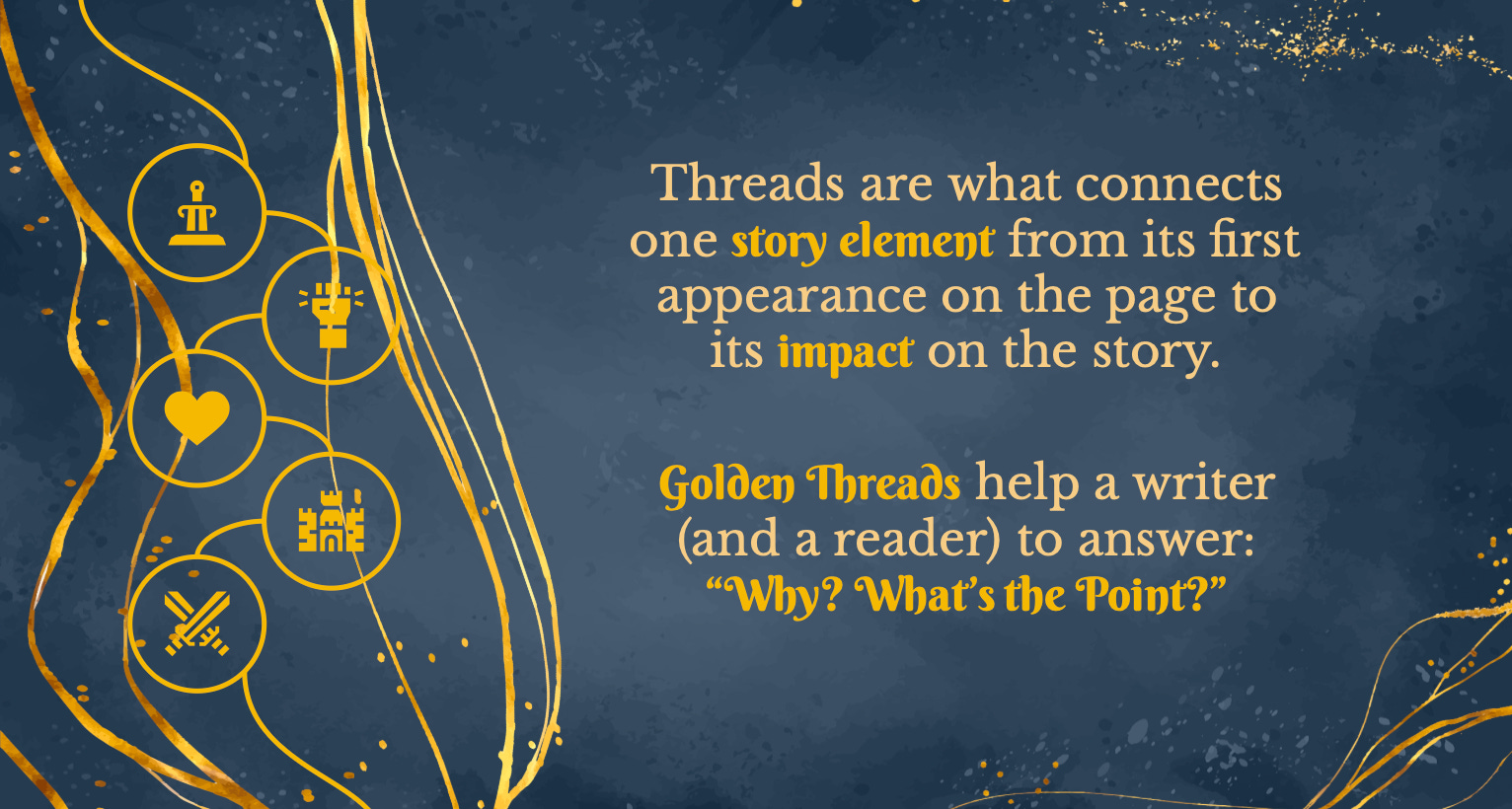
“Golden Threads” is a term that we at Book Dragon Ink use to identify the story elements that make the most impact on the story and the reader.
I like to think that the first “Golden Thread”, the one that holds up all the other threads, be they gold, silver, silk, or cotton, is the “why”. As discussed in my previous article, Why Keep Writing, your “why” is that initial spark of inspiration that caught your attention, that made you commit to this book over every other possible story you might write. It’s the thing that keeps you writing, even when your characters are driving you mad, even when the last thing you feel like doing is parking yourself in a chair to tap/scribble away.
Interestingly, while your “why” might keep you going through multiple drafts, rounds of revisions, and whatever publishing path you take, it can change.
For example, perhaps the idea of writing a treatise on medical ethics using space opera as your vehicle was your original motivation. That initial “why”. But now you’ve fallen in love with your main character, and seeing them through the harrowing character arc they’ve embarked on is what keeps you writing.
Unless the story has shifted so dramatically that medical ethics no longer appears, even in the subtext, I think of that new “why”—that character arc-driven “why”—as a second Golden Thread, entwined, even if only loosely, with the first.
Stories carry many threads, of varying density and importance. But a few always stand out.
The reason you’re writing this book, of all the stories you could choose to tell.
The internal journey your character/s take
The theme, or subtext, that permeates every scene
Relationships between characters, be it romantic or platonic or antagonistic
The primary plot: that external driving force that, on the surface, keeps readers reading. (This is often the primary thread that writers plot out)
Plus, the various subplots that deepen and reinforce your tale.
Listing out the many threads that weave and tangle together to create the story that is truly, uniquely yours can be daunting. Every time I do it, a frisson of excitement quickly explodes into a chasm of overwhelm. Lines of character motivation, romantic entanglements, friend and enemy dynamics, macguffins, narrative tension, and so much more start to feel less like threads and more like a tangle of vines, ready to pull me so far down I can no longer see my story’s throughline.

So what’s an overwhelmed writer to do?
Usually, I start by reminding myself that this feeling of overwhelm, while it may be perfectly valid, is fleeting. There’s a fine line between dismissing valid concerns and letting them master you. But while writing a complex novel (or even a simple one) can be daunting, it is far from impossible. (Obviously, otherwise we wouldn’t have books.)
I also like to read author pep talks or give myself one of my own. Regardless, once I’m in a mindset to do the work, I sit down with a handful of post-its, or index cards, or even just blank paper and a pencil (though this is harder to make changes to).
One by one, I plot the various threads of my novel.
There’s software that can help with this, and while useful, I still find it limiting. There’s something about the tactile nature of real paper that sets my creativity aflame. Plus, the software always has some limitations (though if there is a specific app you use for this that you love, please let me know in the comments).
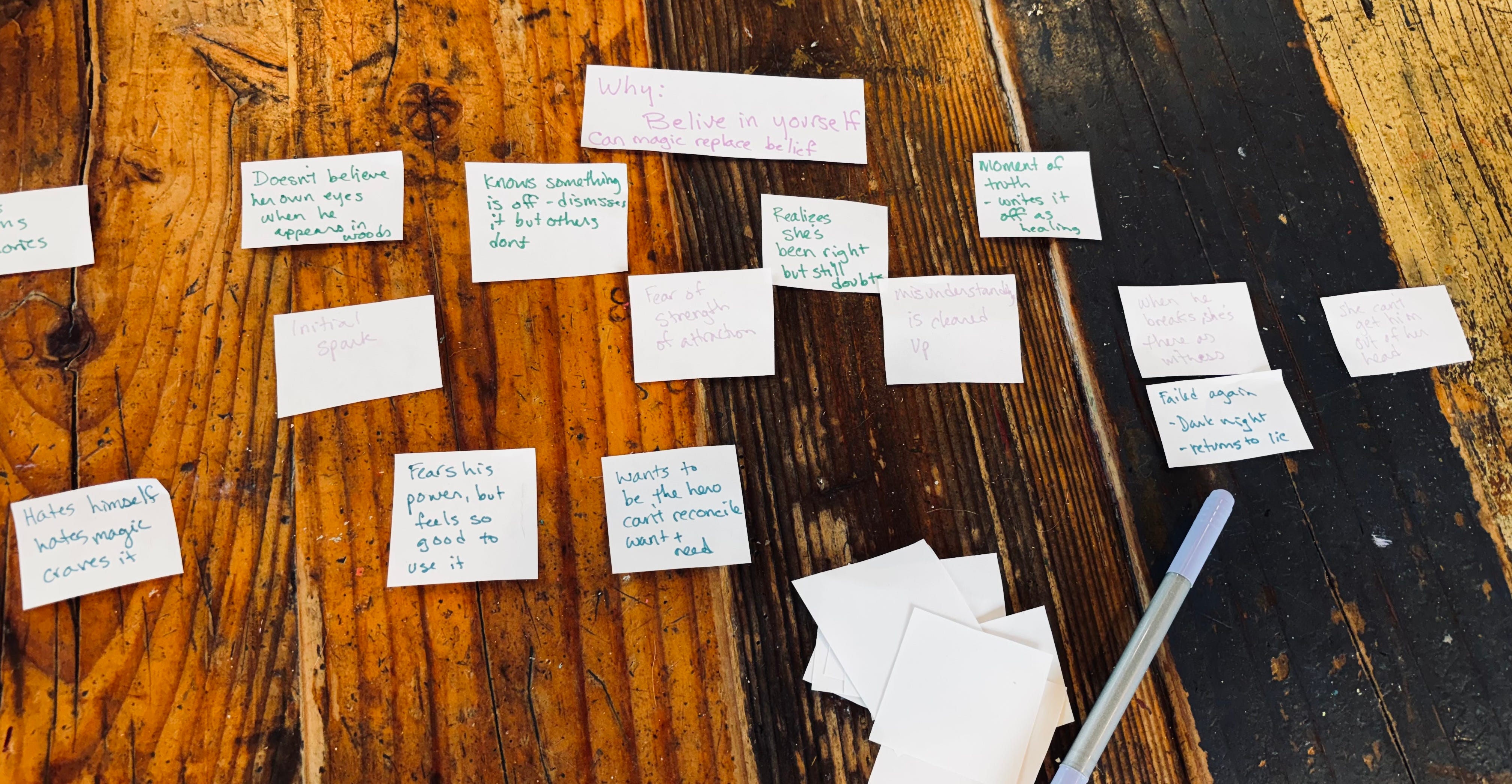
This is different than my plot board, which contains primarily external plot-specific scenes. The threads are the subtext, the in-scene moments, the elements that, when entwined, give the novel the meaning and depth I desire. Eventually, I may add these notes to my plot board so I can be sure the threads are woven together throughout.
Following a thread is similar to outlining my plot. But the threads are often those interior moments that can get lost in the action of the external plot. Tracking them separately allows them to have a weight of their own. And, as beat sheets are often focused on external plot moments (with a few exceptions), this exercise allows me to track all the other moments that don’t drive the external plot, but without them, the story would fall flat.

Here’s what I don’t do:
I don’t work chronologically. I think of one thread and jot down everything I know about it. Each moment is written on a different slip of paper.
I don’t force myself to stick to one thread if I think of a moment from another. I let my mind free associate and lean in to where it takes me. I can always return to the original thread at a later point.
I don’t weave the threads together at this point, or add them to the overall plot structure/outline that I’m working from, though I keep the idea at the back of my mind. If there is a tentpole scene that holds several moments from different threads, I write each moment down on a different card and lay them next to one another.
And I don’t forget to give a little more weight to my golden threads. Theme is often primarily subtext. Character growth happens in the midst of plot and conflict. “Why” I’m writing this story informs these more than it really needs a thread of its own. But I make sure to include them, as often as is relevant.
And, only after I have my threads more or less complete, do I plot them out linearly. This easily turns into a matrix of sorts, a chapter/scene by chapter/scene, barebones list of each thread and the key moments they carry.

At this point, I go back to writing. Or I spend more time fleshing out the missing elements, figuring out how to weave the threads more tightly. Where the story is too thin, or too weighty. As a self-described plantster, I am prone to working in either direction, depending on what feels right that day.
How about you? Outliner or discovery writer or somewhere in between, how and when do you work on untangling these threads?